Open a bank account abroad 2026: the complete guide for non-residents
Opening an account outside your home system: legal, discreet and fully remote. Requirements, process, jurisdictions and costs in the complete 2026 guide.
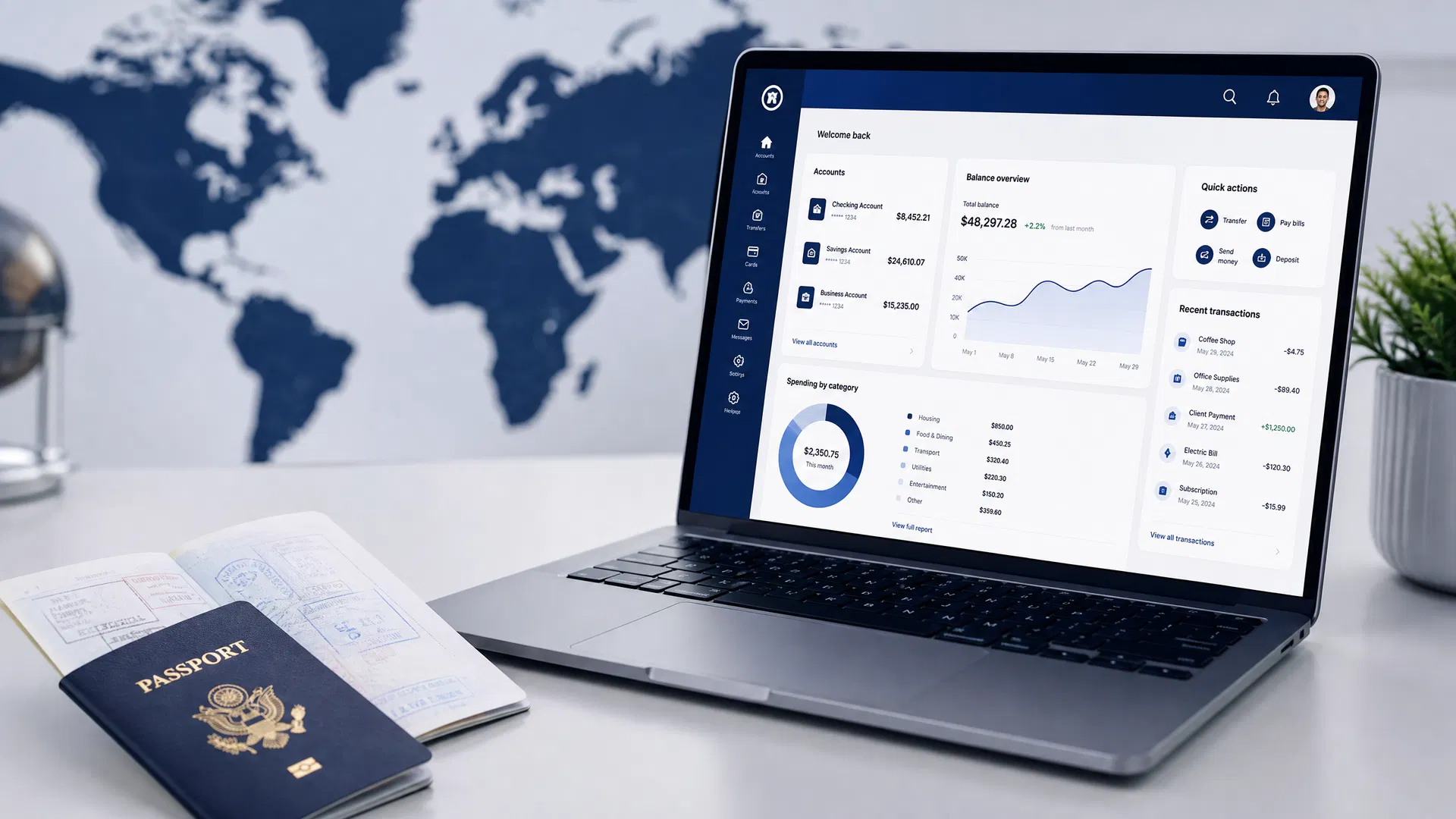
A foreign bank account is not a grey area; it is a legal tool. It gives you access to more stable banks, harder currencies and genuine diversification. Whoever parks their entire wealth at a single bank in a single jurisdiction carries a risk most people underestimate: concentration risk at the level of the state itself.
Opening an account outside your home country is easier today than it has ever been, and yet stubborn myths surround it. This guide gives you the complete walkthrough: what a foreign account is, why you should hold one outside your home system, which requirements really matter, how the opening runs step by step and which jurisdiction fits your situation. All of it legal, discreet and remote.
What is a foreign bank account?
A foreign account is a bank account at an institution outside your country of residence. The decisive point: you open it as a non-resident, without living or being registered there. That is exactly what distinguishes FreedomBanking Plus from classic emigrant banking.
Whoever moves to Portugal or Spain and needs a local current account there opens a resident account on site, presenting registration papers, a local tax number and a rental contract. That is a completely different procedure. The foreign account in the sense of this guide means opening, from the UK or the Nordics, an account in a jurisdiction where you do not currently live.
These accounts exist as a personal account for your private wealth and as a business account for your company. Both work remotely, both follow clear rules, and both are entirely legal.
Why an account outside your home system?
The real question is not whether a foreign account is legal. The question is why so many strategically minded people deliberately bank outside their home system. There are four hard reasons.
1. Protection from bail-in. EU banks operate under the BRRD bail-in regime, UK banks under the Banking Act 2009. In a crisis, creditors and depositors can be made to participate in rescuing the bank. Cyprus 2013 was the blueprint. Accounts outside these regimes do not fall under this machinery. More in our guide to asset protection with an offshore account.
2. Outside the account registers. The EU's central bank-account registers capture accounts inside the EU, and no register in London sees an account in Tbilisi. An account outside these systems is not listed in them. That does not shield you from your tax authority, but it very much shields you from the silent reach of private creditors and automated queries.
3. More privacy. Depending on the jurisdiction, you benefit from minimal or no CRS reporting. What that legally means and where the line runs is explained in detail in our guide to discreet banking.
4. Genuine diversification. A second account in a hard currency, outside your home currency zone and outside your home jurisdiction, is one of the cheapest insurance policies in existence. You spread your capital, your counterparty risk and your political risk.
Why exactly an account beyond your home system is the logical conclusion for every strategically minded person is the subject of Why outside your system?
Is opening a foreign account legal?
Yes, without qualification. There is no law in the UK, Sweden, Denmark, Norway or Finland that forbids you from opening and holding an account abroad. A foreign account is as legal as a second passport or a property abroad.
The other side of the coin matters just as much: a foreign account does not make your income tax-free. As a person fully tax-resident at home, you pay tax on your worldwide income, whichever continent it sits on. The income from your foreign account belongs in your tax return. How that works correctly, which disclosure duties apply and what the automatic exchange of information has to do with it is covered in our guide Declaring your offshore account.
Remember this bright line: legal is the opening and the use; illegal is concealing the income. FreedomBanking Plus works exclusively on the legal side of that line.
Requirements: what you really need
The good news: for a foreign account you need neither a home credit check nor a branch appointment. Foreign banks do not query UK credit-reference agencies or Nordic credit registers. The standard requirements are manageable.
- A valid passport. A national ID card is not enough in many jurisdictions; a passport almost always is.
- Proof of address. Usually a utility bill or a bank statement, no older than three months.
- Proof of source of funds. Banks must know where your money comes from. A salary statement, a sale contract or a bank statement usually suffices.
- A tax identification number. For CRS reporting, many but not all banks require a TIN.
- A short statement of purpose. What do you need the account for? Savings, diversification, business payments. A clear answer speeds everything up.
Whether an account also works without a fixed residence is exactly what our Nomad Package exists to solve. And if the proof of address you hold is an EU one, that single document carries more weight from 2027 onwards: CRD VI makes your member state of residence the test of whether a non-EEA bank may hold the account at all.
How the remote opening works
The biggest misconception is that a foreign account requires boarding a plane. In most of our 31 jurisdictions, everything runs remotely. This is the process with FreedomBanking Plus.
- Choose your jurisdiction and order. You decide online; no initial call needed.
- Document checklist by email. You receive exactly what your bank requires, no more and no less.
- File review. We check your documents for completeness, consistency and bank fit before any bank sees them.
- Personal bank introduction. Your application goes to a named contact at the institution, not into an anonymous call centre.
- Account activation. You receive your credentials directly from the bank.
Why this route has a far higher success rate than any solo attempt is explained under How it works.
Which jurisdiction fits you?
Not every one of the 31 jurisdictions fits every goal. Broadly, two camps can be distinguished.
Discreet jurisdictions. Countries such as Serbia, North Macedonia or the Philippines do not participate in the CRS at all and do not report automatically to your home country. Georgia officially acceded to the CRS in 2024, but in practice the banks there request neither proof of address nor a tax ID, and without that data no usable report can flow. Such locations are attractive for maximum privacy towards third parties and for access to regions beyond your home currency zone. Your tax obligations remain untouched. The current state of play is in our CRS overview.
First-class financial centres with CRS. Switzerland, Singapore and other premium locations do report under the automatic exchange, but offer you maximum bank stability, strong currencies and excellent wealth management in return. For many high-net-worth clients, that is the core of the strategy.
A full comparison of all locations by CRS status, minimum deposit and remote option is on the destinations page. The most popular include Georgia, Serbia, Puerto Rico, Switzerland, Singapore and North Macedonia.
Personal account or business account?
A personal account suits your private wealth, foreign-currency reserves and private diversification. A business account is what you need when a company, an LLC or a holding is to be the account holder.
For entrepreneurs, freelancers and owners of foreign companies in particular, the business account outside the home system is often the real reason for the opening: invoicing in several currencies, international payment partners and a banking location that does not hang from the same thread as the company's registered seat. Details on the business page.
Traditional bank or neobank?
Not every foreign account has to sit at a traditional bank. Neobanks and multi-currency accounts are often the more pragmatic first step for digital nomads and the location-independent.
The difference: neobanks are fast, cheap and app-based, but rarely full banks with classic deposit protection. For your actual wealth base, the road usually leads to a traditional bank. An overview of the best providers is under Neobanks, suitable packages for the location-independent in the Nomad Package. Whoever additionally wants a brokerage abroad finds the options under Brokers.
Why banks reject non-residents
The most common frustration in opening an account abroad is the rejection. The reason is rarely your profile; it is almost always the wrong route to the wrong bank. Banks run a constantly shifting risk appetite towards non-residents, and whoever fires off a blind cold application quickly lands on an internal decline list.
A rejection leaves traces in compliance databases. Every further attempt becomes harder, not just at that bank but system-wide. The four most common rejection reasons and how to avoid every one of them are covered in detail in Why banks reject non-residents.
What does a foreign account cost?
The costs depend heavily on jurisdiction and account type. Fundamentally you should budget three items: the minimum deposit, which ranges from low to substantial by location, the ongoing account fees, and the service fee for the accompanied opening. Premium financial centres demand higher minimums than rising non-CRS locations. The precise comparison per country is in the destinations overview.
Do not count the total as a cost but as an insurance premium. The price of a second foothold outside your home system is minimal relative to the wealth it secures.
The most common mistakes
- Cold applications at several banks simultaneously. Every rejection makes the next one harder.
- Incomplete or inconsistent documents. The most common rejection reason of all.
- The wrong jurisdiction for your goal. Whoever wants maximum stability is in the wrong place at a non-CRS location, and vice versa.
- Concealing income. The only genuine mistake with legal consequences.
A foreign account for your profile
A foreign account is not a niche product for millionaires. Depending on your situation, it serves very different purposes.
The entrepreneur. You run a company with international clients and do not want the registered seat and the banking location hanging from the same thread. A business account outside your home system gives you payment capability in several currencies and a second foothold if your home system wobbles.
The investor. You want part of your wealth out of your home currency and into a hard currency such as the Swiss franc or the US dollar. A foreign account is the starting point; a brokerage abroad the logical complement.
The emigrant and perpetual traveller. You no longer have a fixed residence, or you commute between several countries. A non-resident account is not a luxury for you; it is the foundation of your financial infrastructure, and the Nomad Package builds it.
The digital nomad. You work location-independently and need fast, app-based payment solutions. For you, a combination of neobank and a classic foreign account is often ideal.
The prudent saver. You simply want to sleep better because your wealth no longer hangs on a single point. For you, the diversification itself is the point.
Which currency should you choose?
An underrated advantage of the foreign account is the choice of currency. Every home currency is a political currency with risks of its own. An account abroad lets you hold balances in Swiss francs, US dollars, Singapore dollars or other hard currencies.
The rule of thumb: hold part of your reserves in a currency that does not match your everyday risk. Whoever earns and spends in pounds or kronor gains genuine diversification from a franc or dollar cushion. Many foreign accounts are also multi-currency accounts, letting you switch flexibly between currencies within one account instead of needing a separate account for each.
Documents in detail: avoiding follow-up queries
The most common cause of delay is not the rejection but the follow-up query. Every missing document costs you days. Prepare cleanly.
- Passport, in colour and fully legible, notarised where required.
- Proof of address in your name, no older than three months. A utility statement or bank statement usually works better than a bare invoice.
- Proof of source of funds matching the size of your planned deposit. Whoever wants to deposit 200,000 needs a credible document for that sum.
- A CV or short description of your activity, so the bank can place your profile.
Consistency is decisive: all documents must tell the same person, the same address and the same story. Contradictions are the fastest route to rejection.
The timing factor: why you should not wait
The best time to open a foreign account is before you urgently need it. Openings run most smoothly in calm times, with clean documents and no pressure. Whoever acts only in the crisis moment meets overloaded banks, stricter checks and a crowd of applicants wanting the same thing. A second account is insurance, and insurance is taken out before the damage.
Frequently asked questions
Is opening a foreign account legal? Yes. Opening and holding an account abroad is fully legal. Only the income remains taxable, declared in your tax return.
Can I really open a foreign account remotely? In most of our 31 jurisdictions, yes. The whole process runs by structured email, including the personal bank introduction.
Do foreign banks check my home credit record? No. Banks abroad do not query UK credit-reference agencies or Nordic credit registers. Your credit history at home is irrelevant to the opening.
Does a foreign account make my income tax-free? No. As a fully tax-resident person you pay tax on your worldwide income. A foreign account changes nothing about that.
Which jurisdiction is the best? That depends on your goal. For maximum privacy towards third parties, non-CRS locations fit; for maximum stability, first-class financial centres such as Switzerland or Singapore.
What we do differently
We work with direct contacts at banks in over 30 jurisdictions. When we introduce you, your application does not land in the general inbox: it lands with a person who knows who we are and what we expect of our clients.
Then there is the preparation. We review your documents before they are submitted, make sure everything is consistent, and prepare the application so that it anticipates the compliance team's questions instead of raising them.
This is not a magic wand. There are jurisdictions and banks where even we cannot help. But the success rate is far higher than any solo attempt.
Ready for your account beyond your home system?
You choose your jurisdiction; we take over the rest: document checklist, file review and the personal introduction to a named banking contact. No initial call needed; everything runs by structured email, in English.
Choose your jurisdiction and order now or request your free consultation.
FreedomBanking Plus is the international bank account unit of STM Corporate Group, your partner for fully legal accounts beyond your home system since 2006.